
For a lot of classic Ford owners, part of the pleasure of driving an older car is the mechanical connection between driver and machine. A responsive engine, a manual gearbox and the distinctive character of a classic Ford are difficult to replace.
However, classic motoring can become less enjoyable when an original four-speed gearbox is asked to cope with modern driving conditions. At open-road speeds, engine revs can be high, cabin noise can increase, and longer journeys may feel much busier than they need to.
A Ford 5 speed manual transmission classic car conversion can provide an effective solution.
Rather than changing the character of the vehicle completely, a carefully selected five-speed gearbox conversion can make a classic Ford more practical and enjoyable to drive. The additional gear is particularly useful for open-road cruising, while a properly engineered conversion allows the car to retain the involvement of a traditional manual transmission.
At Conversion Components, we develop and manufacture gearbox conversion kits and adaptor components for a wide range of classic vehicles, including Ford applications.
Why Convert a Classic Ford to a 5 Speed Manual Transmission?
Many classic Ford vehicles were designed at a time when road conditions, typical cruising speeds and owner expectations were different from today.
A four-speed gearbox may still work perfectly well around town and on shorter journeys. The limitation often becomes noticeable on longer trips.
With no fifth gear available, the engine may be operating at relatively high RPM at cruising speed. Depending on the engine, differential ratio, tyre diameter and original transmission, this can mean more engine noise and vibration.
A five-speed transmission provides an additional ratio that can make the vehicle better suited to modern use.
Potential advantages include:
- Reduced engine RPM when cruising in fifth gear
- Less engine and drivetrain noise on longer journeys
- More relaxed open-road driving
- Improved gear selection from a more modern transmission
- Potential reduction in mechanical wear during sustained cruising
- Retention of the involvement of a manual gearbox
- Greater practicality for owners who regularly tour in their classic car
The objective isn’t necessarily to make a classic Ford feel like a modern vehicle. For many owners, the goal is simply to improve usability without losing the character that makes the car enjoyable.
Why the Fifth Gear Makes Such a Difference
The principal advantage of a five-speed conversion is usually the additional cruising ratio.
On many five-speed transmissions used for classic-car conversions, fourth remains approximately a direct 1:1 ratio while fifth provides an overdrive ratio.
This means the car can behave much as expected through the lower gears, while fifth becomes the cruising gear.
The exact reduction in engine RPM depends on several factors, including:
- Fifth-gear ratio
- Differential/final-drive ratio
- Tyre diameter
- Engine speed
- Vehicle speed
This is why selecting a gearbox should involve more than simply finding a transmission that physically fits.
The complete drivetrain needs to be considered.
Choosing the Right 5 Speed Gearbox for a Classic Ford
There is no single five-speed transmission that is ideal for every classic Ford.
Engine capacity, available space, vehicle weight, intended use and final-drive ratio all need to be considered.
Conversion Components offers Ford applications designed around Toyota five-speed gearboxes, including T50 and Supra units.
Examples include conversions for early English Ford four-cylinder engines and Ford Escort applications. Depending on the specific application, available conversion components can include a cast aluminium bellhousing, clutch plate, clutch operating components, pressure plate and speedometer cable.
The important point is that the gearbox and conversion components need to work together as a complete system.
Toyota T50 5 Speed Gearbox Conversions
The Toyota T50 is one gearbox used in a number of classic-car conversions.
For suitable Ford applications, it can provide the benefits of a five-speed transmission in a relatively compact package.
Conversion Components lists an early Ford four-cylinder to T50 conversion for English Ford 1500cc and 1600cc engines, with the starter on the right-hand side of the vehicle.
Components specified for this application include a cast aluminium bellhousing, pilot bush sleeve and gaskets, conversion clutch plate, clutch fork, pivot, thrust bearing and carrier, pressure plate and speedometer cable.
There is also a Ford Escort to T50 application covering specified English Ford 1500cc, 1600cc and 2000cc engines.
Compatibility should always be confirmed for the individual vehicle before ordering components.
Ford Escort to Supra 5 Speed Conversion
Another option offered by Conversion Components is a Ford Escort to Toyota Supra five-speed gearbox conversion.
The listed application covers specified English Ford four-cylinder engines in 1500cc, 1600cc and 2000cc capacities.
The conversion is designed around components that allow the Ford engine and five-speed transmission to operate together, including a purpose-designed cast aluminium bellhousing and associated clutch components.
A properly engineered bellhousing is particularly important because it does more than simply connect two components. Correct alignment between the engine and gearbox is essential for clutch operation, input-shaft positioning and drivetrain reliability.
A Gearbox Conversion Is More Than an Adaptor Plate
One of the common misconceptions surrounding classic-car transmission conversions is that fitting a different gearbox simply requires an adaptor.
In practice, a successful conversion involves several systems.
Depending on the vehicle and gearbox combination, these can include the:
Bellhousing: Connects the engine and transmission while maintaining correct alignment.
Pilot bearing or bush: Supports the gearbox input shaft.
Clutch plate: Must suit the relevant flywheel and pressure plate while also matching the gearbox input spline.
Clutch release mechanism: The fork, pivot, thrust bearing, carrier and hydraulic components must operate correctly together.
Gearbox mounting: The transmission needs to be supported securely and at the correct position and angle.
Driveshaft or propshaft: Length and connection requirements can change when another transmission is installed.
Speedometer drive: A suitable cable or electronic conversion may be required.
Gearlever position: The location of the shifter needs to suit the vehicle’s interior and transmission tunnel.
Considering these items as an integrated package can make a conversion considerably more straightforward.
Preserving Classic Character While Improving Usability
Modifying a classic car is always a personal decision.
Some owners want complete originality. Others want a car they can drive frequently, including on long-distance tours and modern roads.
A five-speed conversion is particularly attractive to the second group.
The original engine can remain an important part of the car’s character while the transmission provides a more useful spread of ratios.
Around town, the driving experience can remain recognisably classic. Once the road opens up, fifth gear gives the driver an additional cruising option.
For owners who actually use their classic Ford rather than simply display it, that can be a worthwhile improvement.
Installation Considerations
Gearbox conversion work requires careful installation.
Conversion Components recommends that its gearbox conversion products be installed by a qualified automotive technician. Installation instructions are supplied with orders.
Before beginning a Ford five-speed conversion, it is important to establish the exact engine and vehicle specification rather than relying solely on the model name.
Classic vehicles may have undergone engine, clutch, differential or transmission changes during previous ownership.
An experienced installer should check areas such as:
- Engine and gearbox compatibility
- Bellhousing alignment
- Clutch operation
- Pilot bearing engagement
- Gearbox mounting
- Propshaft dimensions and alignment
- Gearlever position
- Exhaust and transmission-tunnel clearance
- Speedometer operation
- Fluid levels and specifications
Careful planning before installation can prevent expensive problems later.
Is a Ford 5 Speed Conversion Worth Considering?
For an owner who primarily wants factory originality, the original transmission may remain the preferred option.
For owners who regularly drive their cars, however, a five-speed conversion can offer a useful balance between classic character and modern-road practicality.
The biggest difference is often experienced on longer journeys. Selecting fifth gear and reducing engine speed can make cruising feel substantially more relaxed.
A five-speed gearbox will not transform a classic Ford into a modern car—and for most enthusiasts, that isn’t the objective.
Instead, the aim is to make a classic easier to use while preserving the experience that made the vehicle appealing in the first place.
Ford 5 Speed Manual Transmission FAQs
Can I convert my classic Ford from a 4 speed to a 5 speed manual transmission?
Yes, many classic Ford applications can be converted to five-speed transmission. Compatibility depends on the particular engine, vehicle and gearbox. Conversion Components offers five-speed conversion solutions for several Ford applications.
What 5 speed gearboxes can be used with classic Ford engines?
Depending on the application, Toyota T50 and Supra five-speed transmissions are among the gearboxes that can be adapted to classic Ford engines. The appropriate transmission depends on the engine, vehicle and intended use.
Does a 5 speed gearbox reduce cruising RPM?
If fifth gear is an overdrive ratio, engine RPM at a given road speed will normally be lower than when using a direct fourth gear. The exact reduction depends on the gearbox ratio, differential ratio and tyre size.
Will a 5 speed conversion make my classic Ford better for motorway or open-road driving?
For many owners, this is one of the main reasons for carrying out the conversion. Lower cruising RPM can reduce noise and make sustained higher-speed journeys more relaxed.
Does the conversion require a special bellhousing?
When mating an engine and gearbox that were not originally designed to work together, a purpose-designed bellhousing or adaptor arrangement is generally required. Conversion Components manufactures cast aluminium bellhousings and adaptor components for its supported conversions.
What comes in a Conversion Components gearbox conversion kit?
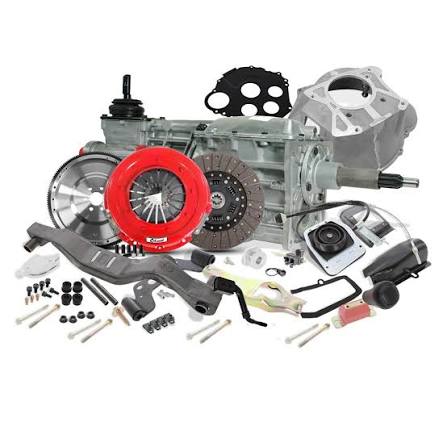
The exact contents depend on the vehicle and conversion. Typical components can include a cast aluminium bellhousing, pilot bearing and sleeve, clutch fork and pivot, slave cylinder, thrust bearing and carrier, conversion clutch plate, pressure plate, speedometer components and, for some applications, a crossmember.
Can I install a 5 speed conversion myself?
Transmission conversions require good mechanical knowledge and appropriate equipment. Conversion Components recommends installation by a qualified automotive technician.
How do I know which gearbox conversion suits my Ford?
Identify the exact vehicle, engine and current transmission before choosing a conversion. Because older vehicles may have been modified during their lifetime, confirming what is actually fitted to the car is important. Contact Conversion Components with your vehicle and engine details to discuss the appropriate conversion.
Upgrade Your Classic Ford with Conversion Components
A Ford 5 speed manual transmission classic car conversion can make a significant difference to how enjoyable an older Ford is on today’s roads.
With the correct gearbox, bellhousing, clutch components and installation, a five-speed conversion can provide more relaxed cruising while retaining the engaging manual driving experience that makes a classic Ford special.
Conversion Components has been developing and manufacturing five-speed gearbox conversion solutions for classic vehicles for decades, with conversion kits and specialist components available for Ford and many other classic marques.